-
-
Adébayo Bolaji
British, born 1983
Lives and works in London, England
Adébayo Bolaji (born 1983) is a British artist whose multidisciplinary practice centers on painting and sculpture. Born in West London to Nigerian parents, Bolaji initially pursued a different path: as a teenager he performed in West End theatre and even earned a law degree before ultimately turning to visual art. He achieved early success as an actor, but found this path unfulfilling and sought a more personal creative outlet beyond the stage. In his early thirties Bolaji took up painting—without formal art-school training—and immediately discovered in it the creative freedom and authenticity he craved. Describing himself as largely self-taught, he notes that his background in acting and law furnished him with useful tools for his art, such as a habit of probing “the right questions” and a flair for narrative storytelling. This unorthodox journey from stage and courtroom to studio has in turn given Bolaji’s artwork an interdisciplinary perspective.
Since embracing painting, Bolaji has developed a dynamic studio practice that fuses multiple disciplines. He characterizes the core of his work as a “dialogue of change,” a continuous exploration of transformation and the act of letting go. Critics have observed that Bolaji’s multifaceted approach functions as an introspective inquiry into personal history—essentially a form of self-psychoanalysis expressed through art. Recurring themes across his oeuvre include cultural identity, collective memory, and the individual’s role in society. Bolaji draws equally from his Nigerian heritage and his British upbringing, reflecting what it means to live between cultures. Often he incorporates materials like African textiles and found objects into his paintings as symbolic elements, using them to address questions of heritage, change, and continuity in a contemporary context. In this way, concrete cultural narratives are interwoven with universal ideas of personal growth and adaptation throughout his work.
Bolaji’s visual style is distinctive for its bold synthesis of figuration and abstraction. He constructs allegorical compositions in which human figures emerge from fields of vibrant color and fragmented form. These dynamic, kaleidoscopic scenes are rich with symbolism, often evoking a dreamlike atmosphere charged with psychological depth. Art-historical and cultural influences are woven into this style: Bolaji finds inspiration in the storytelling rituals and aesthetic motifs of Yoruba culture, including influences from the Oshogbo art movement of Nigeria, evident in his use of intricate patterns and rhythmic lines. At the same time, he channels the urban energy of contemporary London, blending these elements into what he has called a “visual collage” that seeks truth without hiding the process of its making. Bolaji works in an improvisational, intuitive manner, likening the act of painting to a dance that balances accident and intention. This openness to chance contributes to the richly layered surfaces of his canvases, as colors and forms are built up then partially scraped away, revealing traces of earlier layers. Bolaji sometimes inscribes his own signature repeatedly within a painting—a gesture born of past pressure to Anglicize his name and now serving as a proud reaffirmation of identity.
Bolaji’s artistic trajectory since his shift to painting has been one of rapid development and increasing recognition. His first solo exhibition in 2018 explored the transformative power of color as a tool for healing and self-expression. In subsequent years he mounted further solo shows at galleries and museums internationally and participated in artist residencies. By 2024, Bolaji’s work had earned a significant institutional milestone with a solo exhibition at the renowned Arnolfini in Bristol. While observers place Bolaji among a new generation of artists navigating hybrid cultural identities, he himself resists being pigeonholed by ethnicity or geography and emphasizes his identity as a Londoner of Nigerian descent, challenging simplistic labels in the art world. Today Bolaji lives and works in London, channeling his diverse background into a cohesive creative practice that continues to evolve.
While he has extended his exploration into sculpture, film, and other media, painting remains central to his output. This focused presentation highlights the painterly vision that drives Bolaji’s practice, allowing viewers to engage with the vibrant narratives and emotive symbolism that define his art. Through these richly layered canvases, Adébayo Bolaji has emerged as a compelling voice in contemporary art—one who brings depth and imagination to the enduring questions of identity and change.
-
-
-
"Because of Love consists of two elements: a large dark wood square frame and a smaller rectangular painting on cotton duck canvas... In the center of the painting is a solid orange rectangle framing an abstract portrait of head drawn with a confident white line. It is reminiscent of a postage stamp. The squared head is facing to the right, has pouty lips, a button nose, deep set eyes, seven short spikey strands of hair, and a lump at the nape of their wide neck… There are two rows of short painted strokes of yellow, pink, green, blue, and orange that border the rectangle, creating the illusion of running stitches or embroidery from afar. Every line has its own character; no two lines are the same. There are also rows of small yellow and pink buttons decorating the rest of the canvas. The painting is suspended in the center of the square frame and held in place by neat, taut lines of multicolored thread, which keeps it lying flat. The lines of thread are looped through gold and silver eyelets, punched through the perimeter of the canvas and wound around the wooden frame, creating thick bands of color along the wood. Love is an abstract idea that is often seen as something that is beautiful and tied to notions of beauty... Bolaji has said, 'sustaining these qualities sometimes becomes a cult-like status, but what are the driving forces that lead us to believe in a myth of universal beauty, despite its evolving nature?'"
— Gallery guide for In Praise of Beauty, a solo exhibition for Bolaji at Arnolfini in Bristol, UK
-
-
"His painting has gained a massive following, especially among younger audiences on Instagram. It might be the honest juvenility of his approach that attracts those looking to break away from traditional techniques. He describes his process as a kind of liberating 'play' where, 'you have to come into a room and say I know nothing.' He continues, 'I know it sounds pretentious but it’s more enjoyable when you can let go.' Bolaji’s strong emphasis on following and trusting the line is certainly ludic. Doodle-like scribbles and marks of colour metamorphose throughout the process. Sometimes lines fill the canvas to form homogenising, claustrophobic abysses. In other more open paintings line and colour emerges subtly from lower layers that have been painted over in more definite blocks. Both Freud and Winnicott cite play as a means of healing: it allows for the expression and reconciliation of unconscious emotions and anxieties. It is an apt metaphor for Bolaji’s paintings, for play transgresses the barrier between the individual’s inner world and the world outside."
— Lucy Walmsley, Tank Magazine
-
-
"Painting seemingly provides Adébayo with all the things he is instinctively attracted to: a sense of control, immediate expressiveness and colour. 'For years I could walk past something that had a great use of colour and I would feel helpless inside, really pulled by it, wanting to be part of the conversation and not knowing how,' says the artist. 'But when I came to paint it was like several light bulbs were going off and going crazy, like bingo bingo bingo.'"
— Jynann Ong, It's Nice That, quoting Adébayo Bolaji
-
-
“For me, color isn’t just a visual choice — it’s a resonant field. By resonant field, I mean the invisible atmosphere that color creates — the way colors vibrate, interact, and amplify one another across a surface, shaping not just how we see, but how we feel. It’s the emotional and energetic space a color palette opens up, where each hue doesn’t just sit alone but affects — and is affected by — the others, creating a living, felt presence on the canvas. I work instinctively, listening for what a painting is asking for — where it wants to pull or vibrate. Because it’s visceral for me — it always has been… very intense, actually. Color becomes a way of creating space, of opening up areas within the canvas that hold emotional or spiritual weight. I’m drawn to deep contrasts — color as tension, as softness, as pause. I’m aware that people sometimes sense echoes of North African sensibilities because of the symbols I use, and Yoruba sensibilities or broader African visual rhythms in my work — but I don’t approach it consciously. It’s more like these patterns and sensibilities live in the residue of who I am. At least I think so, for now… memory, geography, ancestry — something like that. Growing up in a large Nigerian household in West London, Nigeria isn’t something I need to force into the work — it’s already there. It lives in my palette, my rhythms, even my silences. But it’s not static; it’s evolved, just as I’ve evolved. And I’m grateful for that. The Nigeria in my art is not a nostalgic flag or fixed identity — it’s a living pulse — and I’m not sure one can teach that, per se. Ultimately, my palette is shaped by continued lived experiences."
— Adébayo Bolaji
-
-

-
-
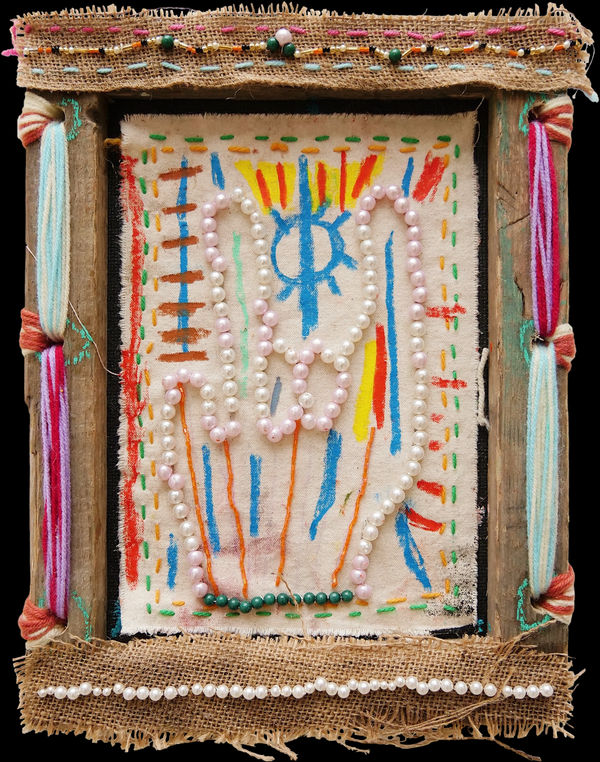
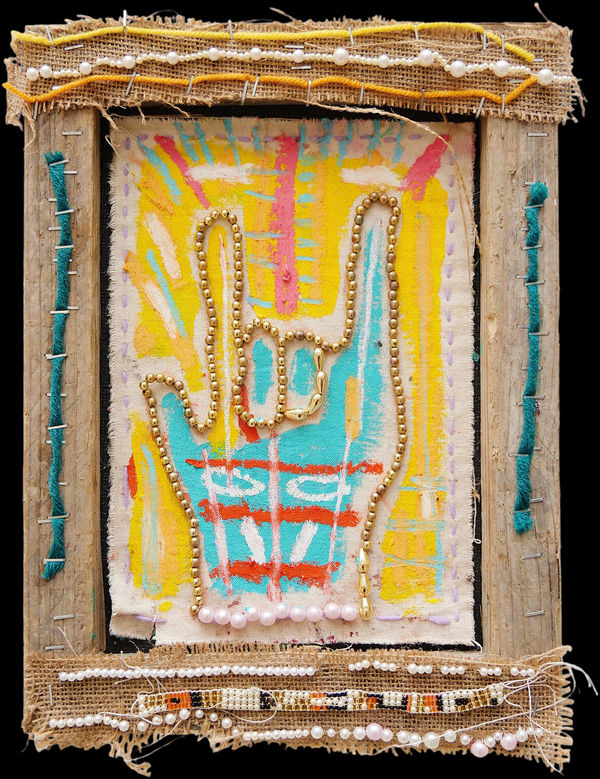
"I Love You"
“I love you in sign language. Here I used the same sign, expressed differently in each piece acting like a motif…my mother could communicate (in part) through sign, and taught me a few expressions when I was younger…"
— Adébayo Bolaji
-
"The mixed-media series I Love You relies on the colours and textures of not only its own composition but also its accompanying sister pieces, playing into Bolaji’s ideas about the subjective and objective, and how our perceptions of beauty are often shaped by our environments."
— Fey Donoghue, Metal Magazine
-
-
Works Shown
-
Adébayo Bolaji
Current viewing_room