-
Jordy Kerwick
-
Installation Shots
-

-
Artworks on View
-
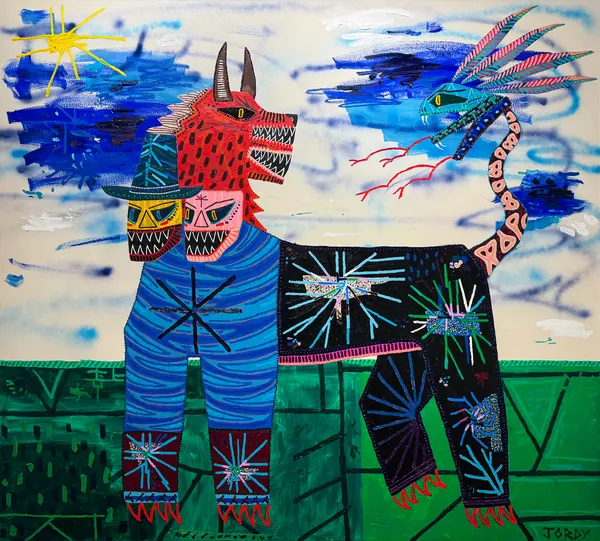
Protection / Destruction (2025), Oil, acrylic, and spray paint on canvas, 71" x 78 3/4" (180.3 x 200 cm)
$ 50,000.00 -
-
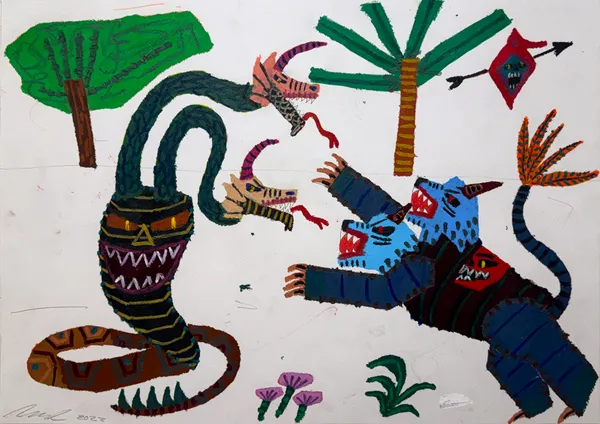
Not Done Yet (2025), Oil, acrylic, and spray paint on canvas, 39 3/8" x 47 1/4" (100 x 120 cm)
$ 35,000.00 -
-
-
Mythology and Iconography
Kerwick’s imagery draws on folklore not as a set of fixed symbols, but as a way of constructing drama through recurrent figures. As the artist has said, folklore depends on “distinctive characters and symbolism” and on oppositions such as “life and death” and “fear and bravery.” That logic underlies the repeated appearance of wolves, tigers, cobras, unicorns, and multi-headed creatures in his work: they are less illustrations of a known myth than the protagonists of an invented one. Their function is not to decode the image, but to animate it through conflict, tension, and transformation. -
Color, Pattern, and Pictorial Space
Kerwick’s paintings are driven not only by iconography, but also by formal questions of color, pattern, and spatial compression. In conversation with Nick Hackworth, he noted that in some works “the subject matter is void” and that the real problem is “nailing the blues and oranges and reds.” In the same interview, reflecting on earlier abstract work, he emphasized placement, negative space, and the difficulty of understanding space in painting, adding that “it’s all the things you choose not to do that ultimately makes the painting.” Even his most figurative images remain grounded in painterly concerns: chromatic tension, controlled flatness, and the measured withholding of detail. -
Process and Structure
Kerwick has described his work as “rough and raw and very unrefined,” adding that “the more mistakes, the merrier” because they “add life to a painting.” At the same time, he has said that his process “starts with a scribble, then moves onto a more structured drawing, then some turn into paintings.” The work’s immediacy is therefore not simply accidental, but emerges through a process that moves between spontaneity and structure. -
-
-
"I urge everyone to see Jordy’s paintings in the flesh; his bold palette and folkloric, menacing cast of characters transport you into an otherworldly fairy-tale."
—Aurore Ankarcrona Hennessey, Director of Art, The Arts Club, London
-
Directness and Compression
Kerwick has described his paintings as “playful, pretty raw” and “bold,” adding that they are meant to be “something people can understand with relative ease.” That directness is formal as much as thematic. Built through flattened perspective, bold color, and patterned surfaces, the work remains immediately legible while withholding the spatial logic expected of naturalistic painting. Domestic objects, predatory animals, and hybrid creatures are brought into the same compressed field, so that clarity at the level of image coexists with instability at the level of structure. -
-
Youth and Refusal
In a 2022 interview, Kerwick described his work as an attempt to “remain young,” adding, “I’m almost 40 and I don’t want to grow up.” Read now, the point is less his age at the time than the impulse it names: a refusal of composure, finish, and adult restraint. The fantastical beasts, frontal clarity, and childlike compression of his paintings follow from that refusal. What can first appear playful or elementary is bound up with something more deliberate: a commitment to impulsiveness, imaginative freedom, and forms not fully governed by rational order. -
The Beast
-
Paintings and works on paper by Jordy Kerwick are now on view at Serge Sorokko Gallery, 1301 First Street, Napa, CA
1301 First Street, Napa, CA 94559 | 1500 First Street, Napa, CA 94559
(415) 421-7770
www.sorokko.com
mail@sorokko.com
Jordy Kerwick
Current viewing_room